
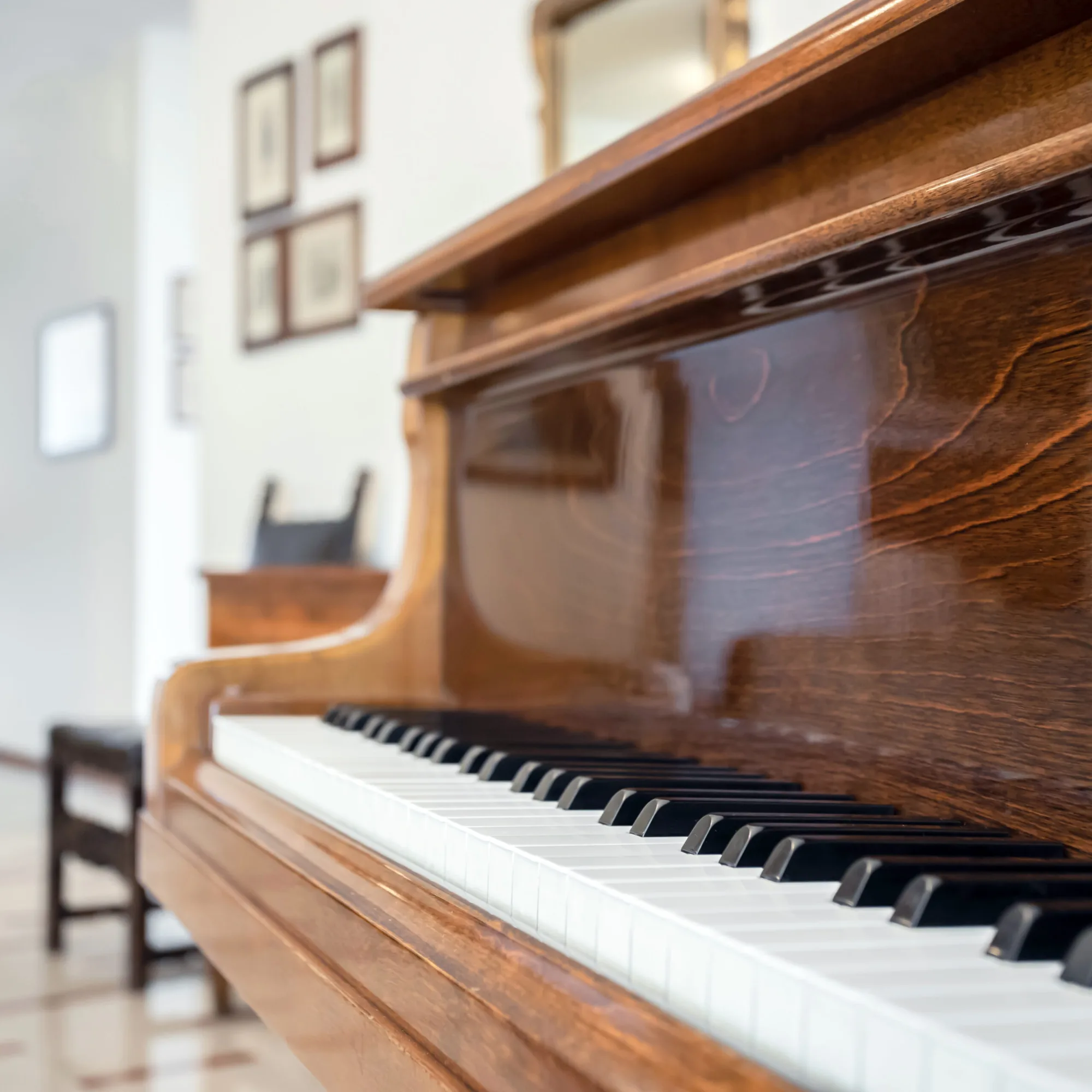
Pianolas are some of the most loved instruments we move. Many have been in the same family for generations, and plenty of Melbourne homes still have one in the front room, often with a cabinet of paper rolls beside it. They are also some of the heaviest uprights we carry.
What is a pianola?
A pianola is a player piano: an upright piano with a pneumatic mechanism built inside that plays the instrument automatically from a perforated paper roll. The player pumps two foot pedals to create the suction that drives the mechanism, and the roll tells the piano which notes to play. Pianola was originally a brand name, but in Australia it has become the everyday word for any player piano.
Most pianolas in Australian homes date from the early 1900s to the 1930s, when they were hugely popular, and many can still be played as an ordinary piano too.
Why pianolas are so heavy
Inside a pianola is everything a normal upright has, plus the player action: bellows, a spool box, tubing and a stack of valves that operate each note. That adds real weight, usually putting a pianola somewhere around 250 to 350 kg. Our guide to how much a piano weighs compares it with other pianos.
Old casters are rarely up to that weight, so we never roll a pianola on its own wheels.
How we move a pianola
- Any roll is removed and the spool box doors are closed and secured
- The lid and fallboard are locked so nothing can swing open
- The pedals are protected
- The piano is lifted onto a padded trolley and strapped, never rolled on its casters
- On stairs, the crew controls it from above and below
- It travels upright, strapped securely in the truck
If you have rolls or a roll cabinet, mention them when you book so we can plan for them too. Our upright and pianola moving page has more on how we handle heavy uprights.
Looking after a pianola after a move
A pianola has the same needs as any piano: a stable room away from heaters, air conditioning and direct sun, and a tuning a couple of weeks after it settles. See should you tune a piano after moving it.
The player mechanism is its own specialty. If the pedals feel weak or notes are not playing from the roll, a player piano technician or restorer can assess the bellows and tubing. We move pianos to and from restoration workshops, so if your pianola needs work we can take it in and bring it home again. Read more in taking a piano to a restorer.
Is a pianola worth moving properly?
Value varies a lot with condition and make, and a restorer or retailer is the best person to ask. What we can say is that a pianola with family history is almost always worth moving properly, because a tipped or dropped pianola is very expensive to put right.
Questions
Pianolas: FAQs
Is a pianola heavier than a normal piano?
Usually, yes. The player mechanism adds weight, so most pianolas weigh around 250 to 350 kg.
Can a pianola be moved up stairs?
Yes, with the right trolley, enough crew and a plan for the stairs. Tell us how many steps there are and whether they turn.
Should a pianola be tuned after moving?
Yes, like any piano, ideally a couple of weeks after it has settled into its new room.
Ready when you are